How could we benefit from blockchains to develop collaborative tools to monitor the economic consequences of climate change?
Climate change is already impacting our economy worldwide, not for the better in most cases, and this phenomenon is expected to grow in importance in the coming decades. There is a need to predict not only future climate parameters but also the resulting economic behaviors of our countries at a macro level.
Decision-makers will require more accurate cost-benefit analyses that take climate change into account, especially in a context of increasing raw material and energy scarcity, further limiting their leeway in their action plans. Major economic issues are at stake, putting pressure on future global welfare.
As a basic example, if in some regions hydroelectric dams are expected to produce less energy because of higher future evaporation rates or lower rainfall amounts, decisions must be taken now concerning the architecture of the electric grids to maintain reasonable electricity prices.
In the same way, what would be the point of subsidizing a food processing plant if its inputs are not expected to grow anymore in the surrounding area? This area would benefit more from accurate economic predictions to prepare its adaptation strategy than from blind subsidies.
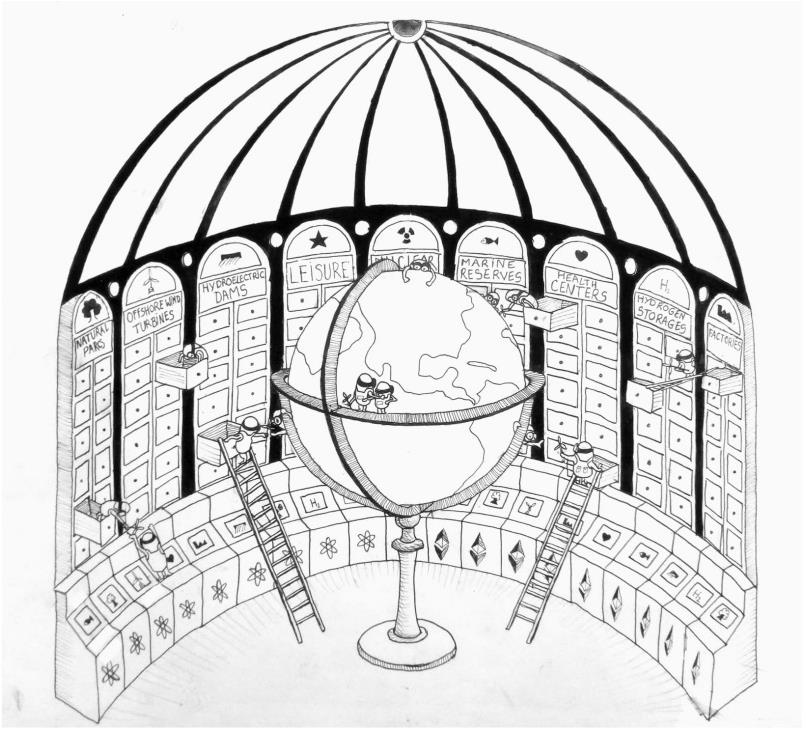
The cooperative nature of blockchain technology could help us model future economic behaviors using a bottom-up approach, turning the future financial consequences of climate change for economic players into macroeconomic predictions. We would thus obtain greater economic resilience for our society.
So, concretely, how could we proceed?
– Bottom level – Impacts on assets
First, let’s translate climate risks into financial values. Indeed, since an economic player, whether from the public or the private sector, relies on its fiscal viability, it makes sense to evaluate the impacts of climate risks by measuring the resulting financial gains or losses on its assets. Any type of asset and any climate risk could be considered, such as physical risks (e.g., changes in the frequency of heat waves or sea level rise) or transition risks like regulatory ones (e.g., a technological ban).
I recently designed a methodology for measuring the financial impacts resulting from climate change on any type of asset, such as industrial plants or companies in the tertiary sector.
– Upper level – Macroeconomic impacts
After analyzing financial impacts for a first set of assets, macroeconomic patterns of the consequences of climate change on each economic sector will already emerge. Indeed, extrapolation of the financial impacts will be feasible for other assets sharing similarities with those previously studied. Then, existing economic tools will help us determine the knock-on effects each economic sector will have on other sectors. An iterative model could be built to produce a final picture of the future state of the economy for every climate scenario and every selected area. I have also already designed this methodology.
Blockchains could help us design such a model. This technology is above all a decentralized architecture for web-based networks. With a native token, anyone using an application on a blockchain can finance additional service providers interested in managing the network hardware. The model could be built on a blockchain as an open-source and collaborative application, removing any lack of transparency in the calculations. Moreover, frequent updates of the input data of such an economic model could be automatically transferred to the application using blockchain oracles such as Chainlink or Band.
It is also worth noting that, depending on the validation process of a calculation, the energy consumption of a blockchain can be sharply reduced. Proof-of-stake blockchains, such as those built on the Layer 0 Cosmos, have a very limited environmental impact compared to proof-of-work ones like Bitcoin.
Economic modelling is an adequate response to the rising complexity of the issues we must face. We surely shouldn’t avoid this option.
Don’t hesitate to contact me if you require economic modelling skills for your strategic decisions. I will be glad to provide tailor-made modelling support.